Cod's head
vs the enchanter, Charles Dickens and his museum

I went to the Dickens museum in London a few weeks ago, right after my train got in from Edinburgh. Its always a shock, grey stones, wind, bitter rain when you get on the train at Waverley, a balmy Ballard like air when you arrive at kings cross and one has to strip off their layers of coat and tartan (actually ). Writers museums are for the most part disappointing beyond fetish items ( a boot, a MS, a pen, a razor) . What do you show? In the DH Lawrence birthplace museum in a suburb of Nottingham I contemplated plastic pork pies and lace doilies. The Brontë Parsonage museum is the only one with any sort of aura, and the odd dimensions of its rooms and size feed your perceptions of the Brontë novels, but the museum insists on annoying exhibitions, which when I visited included a homage to Bramwell by Simon Armitage which demonstrated nothing but Armitage’s pitiful refusal to accept any literary lineage from women writers. I was reading John Carey’s book on Dickens Violent Effigies alongside Dombey and Son, and have recently been fascinated that a big book blogger has an almost hysterical dislike of Dickens, so I suppose I was in the mood. A friend had told me Dombey and Son is one of the rare ones where you are on board with the sentiment and that’s true ( its about a man prioritising sons over daughters) but I read Dickens for the style, for parts like this:
It was a snug room, Mr Feeder’s, with his bed in another little room inside of it; and a flute, which Mr Feeder couldn’t play yet, but was going to make a point of learning, he said, hanging up over the fireplace. There were some books in it too, and a fishing-rod; for Mr Feeder said he should certainly make a point of learning to fish, when he could find time. Mr Feeder had amassed, with similar intentions, a beautiful little curly secondhand key-bugle, a chessboard and men, a Spanish Grammar, a set of sketching materials, and a pair of boxing-gloves. The art of self-defence, Mr Feeder said he should undoubtedly make a point of learning, as he considered it the duty of every man to do; for it might lead to the protection of a female in distress.
But Mr Feeder’s great possession was a large green jar of snuff, which Mr Toots had brought down as a present, at the close of the last vacation; and for which he had paid a high price, as having been the genuine property of the Prince Regent. Neither Mr Toots nor Mr Feeder could partake of this or any other snuff, even in the most stinted and moderate degree, without being seized with convulsions of sneezing. Nevertheless it was their great delight to moisten a box-full with cold tea, stir it up on a piece of parchment with a paper-knife, and devote themselves to its consumption then and there. In the course of which cramming of their noses, they endured surprising torments with the constancy of martyrs: and, drinking table-beer at intervals, felt all the glories of dissipation.
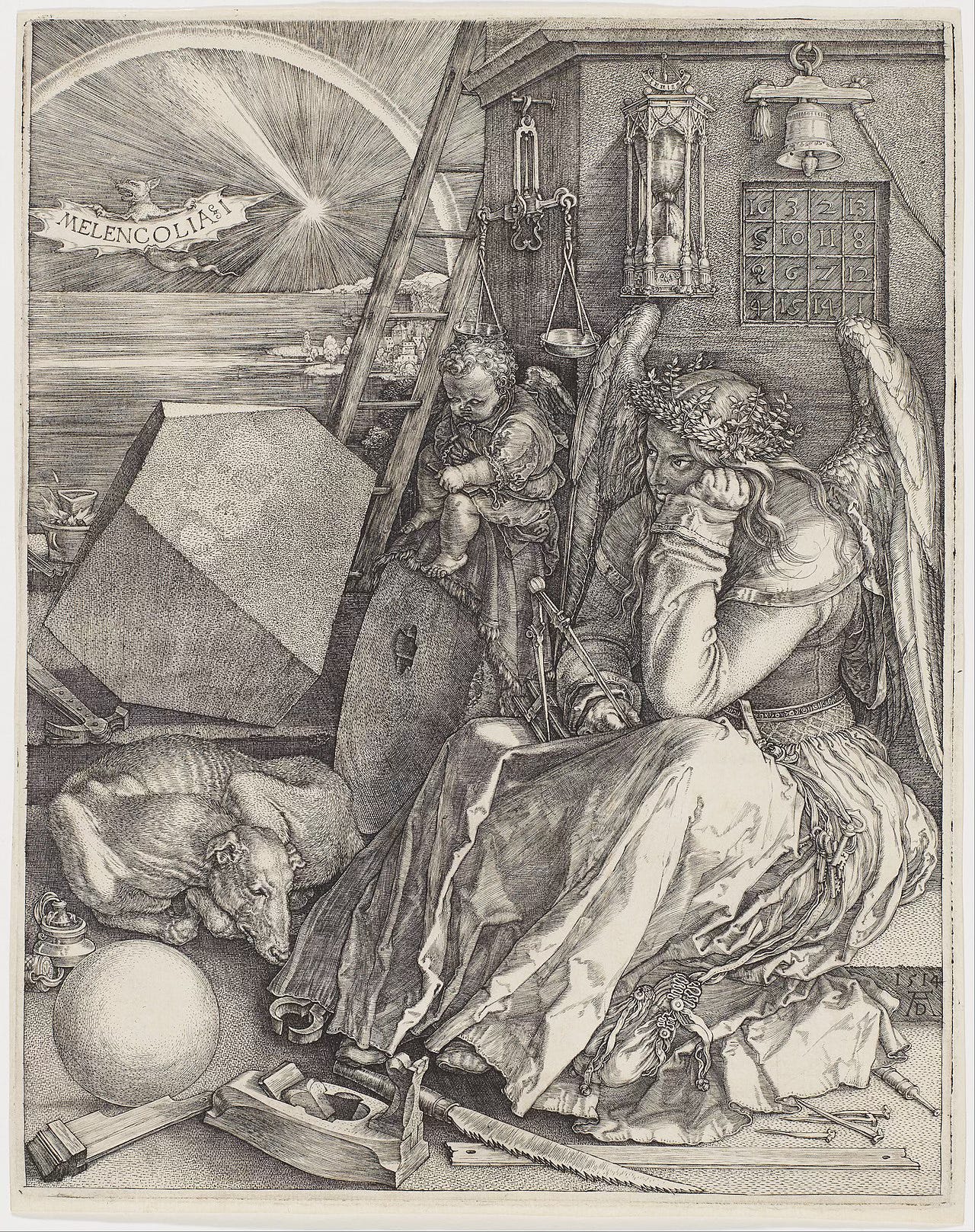
That excerpt from Dombey and Son is filed in the same part of my brain as Dürer’s Melancholia 1 and Robert Lowell’s poem To Delmore Schwartz. A nice little artistic collage across the ages, each conveying an idle, object strewn boyish despondency.
I didn’t see the point of Demon Copperhead, a nod to his plotting and social justice, because for me he is about the style. It is for Dickens, that Nabokov coined the phrase ‘tingle in the spine’ that happens when reading. ‘ As is quite clear, the enchanter interests me more than the yarn spinner or the teacher’ writes Nabokov in his lecture on Dickens.
Dickens lived in the Dickens Museum house for three years, and it is home to the famous painting of him which is all the better for not being finished, and his writing desk. I love fetishism and idolatry!
After a hallway( with his nutmeg grinder on display) and a nice, good Victorian clock, the first room you enter is the dining room, where the table is set with a deranged plaster and clay meal. Fake bowls of raisins and apricot kernels, bowls of tiny red peppers and other mouse sized vegetables and fruit, a moulded ‘jelly’ of course, and a full moon circle of cheese ( Dickens and his wife loved cheese, we learn. Upstairs, by his commode, there is a letter in which he writes to a doctor “I have been bothered for weeks- months, at intervals with distention and flatulency” ) wrongly coloured walnut halves, a bowl of multicoloured shells, another of big jigsaw like sprinkles, both which I assume we are supposed to imagine are made out of sugar, little potatoes, and some brown balls sprinkled with coconut which look like they belong in an unappetising ‘Deliciously Ella’ range, and the kind of glistening, big plastic grapes I remember squeezing and sometimes chewing in the 90s as a little girl to see if they were real. I was early meeting my friend Charlie there, so I idled in the kitchen downstairs and tiny laundry room which one of the staff members followed me into, though I can’t fathom what there was for me to steal, a little nightie, the plastic apples and charity shop Blue willow china in the kitchen. Still damp from the Edinburgh rain, I felt like ‘Good Mrs Brown’ in Dombey, the hag who steals Florence’s clothes for her rag pile. I know Dickens wouldn’t rate me as a woman, sure, but I always meet him writer to writer.
The ‘special exhibition’ on here was about the women in Dickens life. There was a copy of Catherine’s recipe book: Oyster patties, turbots and smelts, ham, pigeon, orange fritters, cod’s head and macaroni. In Violent Effigies Carey writes
As a boy Dickens used to visit a shop in Long Acre which displayed, in tall jars, preparations which had the appearance of ‘unhealthy macaroni’, but proved on closer inspection to be tapeworms ‘extracted from the internal mechanism of certain ladies and gentlemen’ who were delicately referred to, on the receptacles, by initial letters.
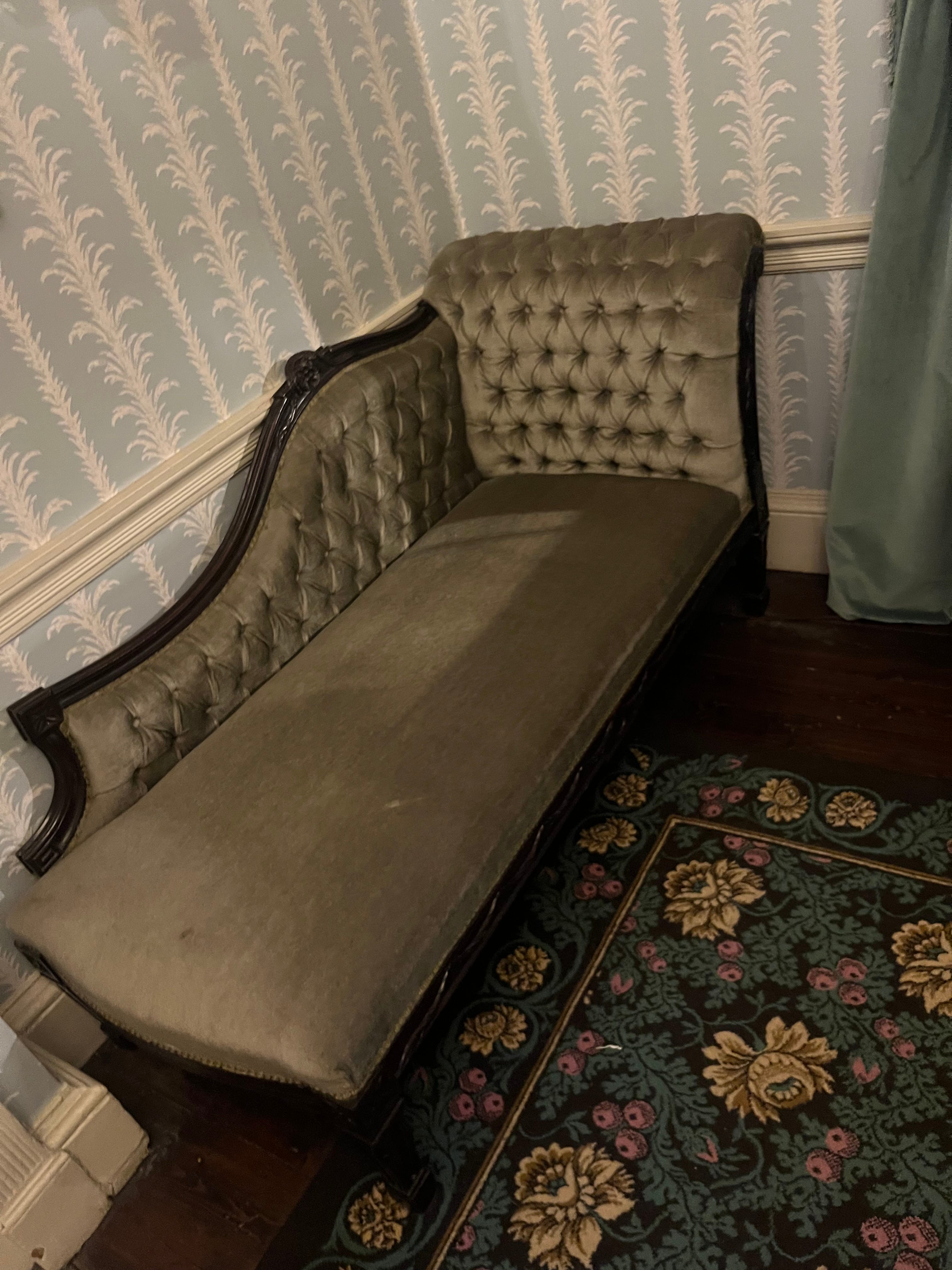
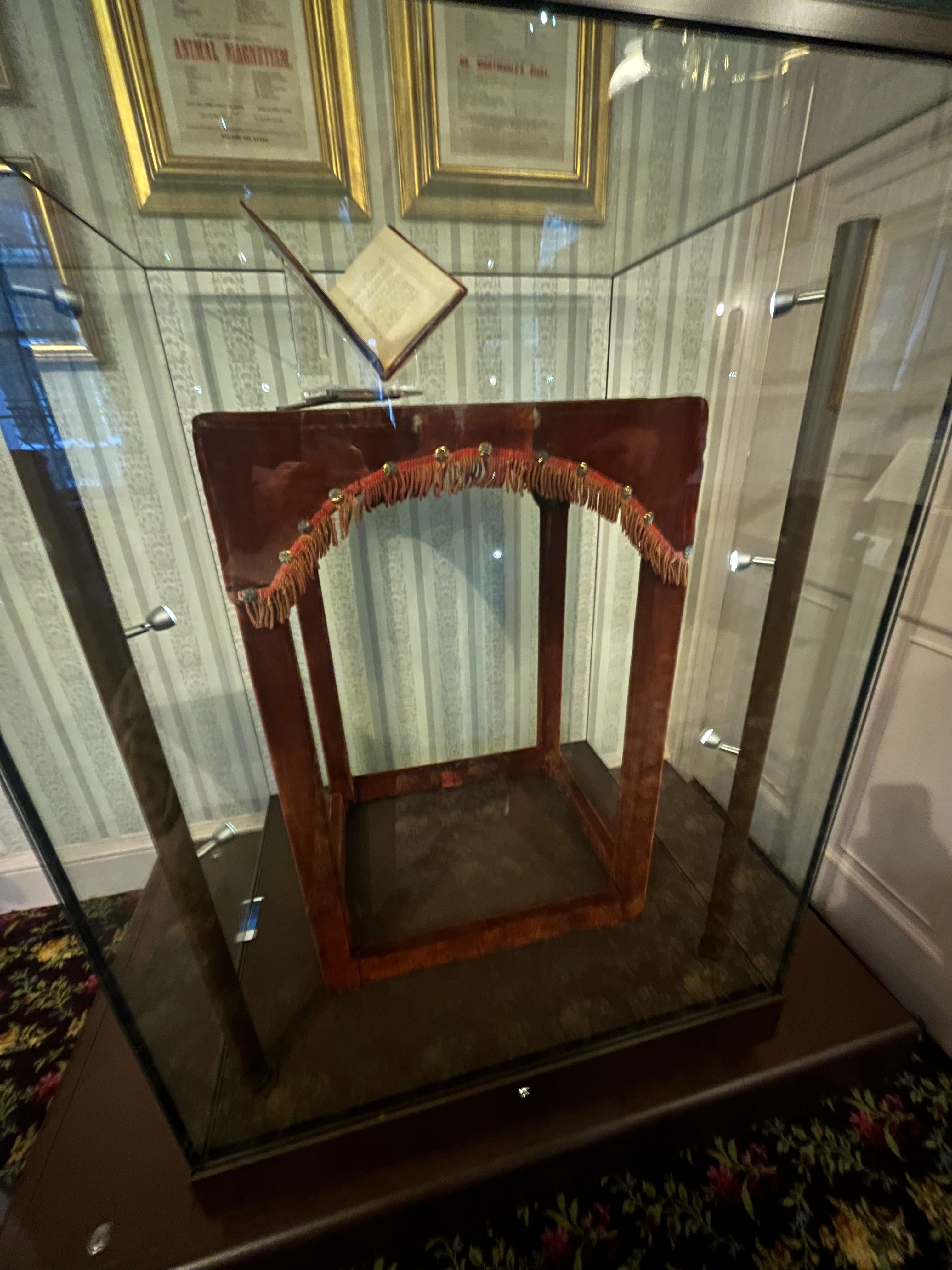
Minus the writing room, with his desk and the painting of Dickens, some wacky candlesticks he bought in Italy which resemble Dresden figurines with twisted bits of silver emerging like warty growths, a glass case in a parlour containing his almost kinky looking velvet reading stand, and paintings of more demure scenes from his novels, most of the museum seemed to be about Catherine and the domestic rather than just the special exhibition. There is nothing particularly Dickensian about the museum.( The NYPL has a perfect example of a Dickensian Dickens’ object, a letter opener made with the paw of his cat Bob.) Dickens separated from Catherine and you felt he was rather being chastised here. Probably the worst thing a writer or artist or anyone else could imagine legacy wise is a museum about them being half dedicated to an annoying ex. There is a room with her jewellery, including her engagement ring, an enormous painting of her and a snail coloured fainting chair, all enclosed in walls with Wedgewood toned wallpaper with a feathery and ejaculative design.
Other parts of the house are a survey of general domestic life in the 19th century. The kitchen informs us that hedgehogs sometimes lived in kitchens to eat all the bugs and I overheard a guide trying to describe porcelain hot water bottles to some other tourists. (The only museum I have been that does this theme well is The Tenement Museum in Glasgow, which still uses gas lamps) I had read that there was a suit or coat of Dickens on display but couldn’t see it anywhere. We were told it had to be removed because the environmental conditions of the house weren’t correct to preserve it. The house had literally been eating it away. Here is the domestic which supported the writer the museum seemed to be telling me. What about his work, his imagination, which upheld and supported this cushy domestic space of sentient pincushions? Dickens worked constantly, wrote himself to exhaustion. I am sick of the elevation of the domestic. It’s a backhanded way of telling me I should go make orange fritters instead of writing books and that child rearing and artistic creation have more in common than crude similes. It's an insult to George Eliot, the Brontë Sisters, Christina Rossetti, Elizabeth Browning. Oyster patties aren’t Middlemarch. The elevation of the domestic is all about interior design, crafts, and flowers and food never about waste, filth, illness, chamberpots, the working class people actually doing the work not just designing the menus. The hidden reality of the domestic is that it is a kind of baleen trying to filth at bay but really having to bask in it. When Vanessa Bell or whomever paints interiors, there is a sanitisation process happening, it’s as unrealistic, as fake as a Victorian painting of a fairy. Thank God I found Dickens’ toilet on display to cut through all the plastic grapes and apples
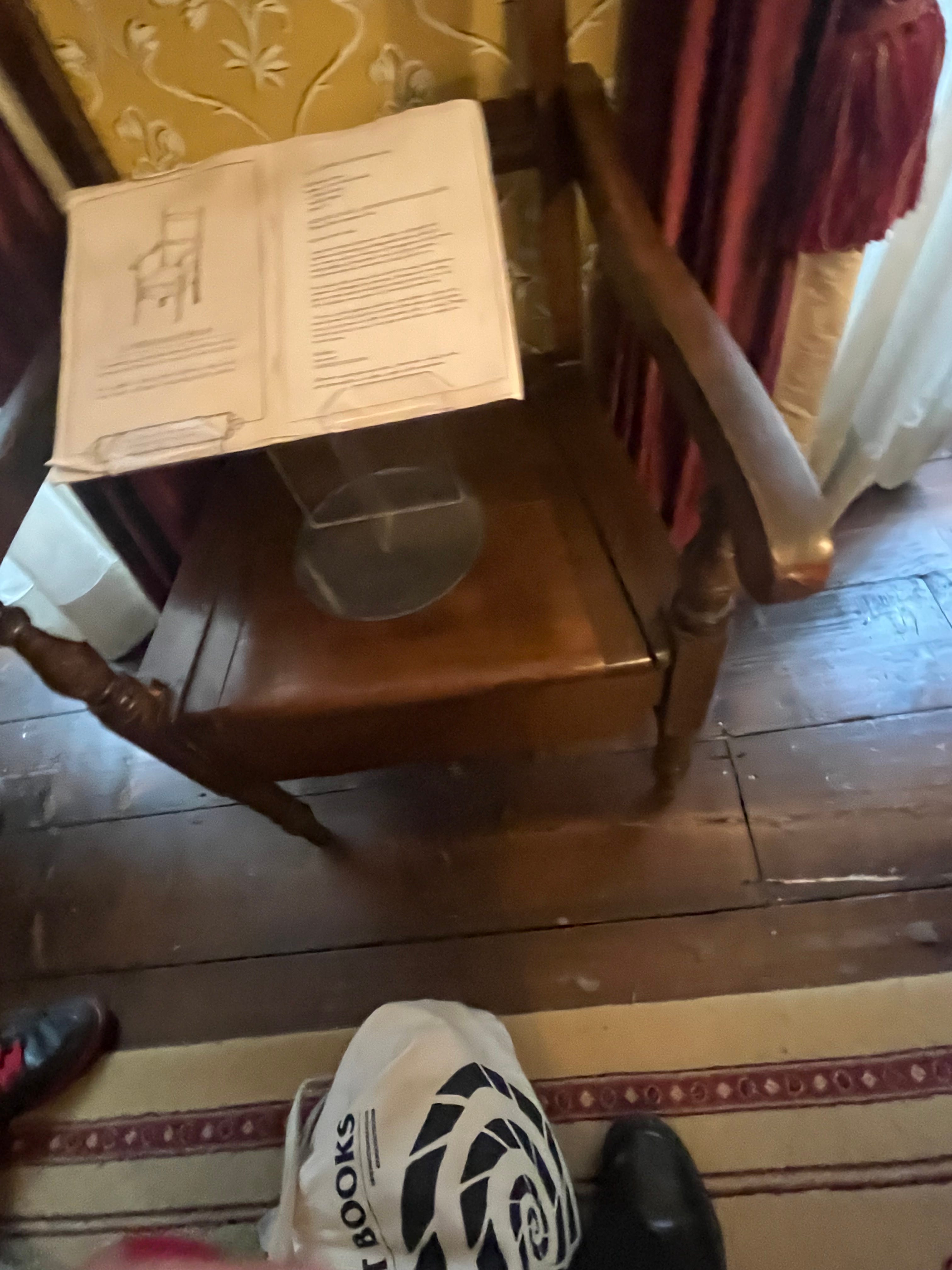
Though this was the only nod to Dickens obsession with waste, his dirty waywardness. If you have plastic food on display, does it not follow you should have plastic turds too, or placentas even . ( The D.H Lawrence birthplace museum, to its credit, has a chamberpot with plastic urine.)
In the gift shop, copies of The Invisible Woman were prominently on display, along with aprons and cups and bowls. Poetically, there should be wigs and taxidermy, bits in jars, tins of anchovies (his fav sandwich was anchovy and egg) . I think the museum would benefit if it, like the Freud museum let artists in and let them fuck around, responding to and interpreting Dickens’ work, an imagining of the waste pile at the centre of Our Mutual Friend. In the last exhibition I saw at the Freud Museum they inserted eerie, many breasted sculptures into his office, hidden among his collection of figurines so you had to guess what was contemporary art and what wasn’t, a bit of an easter egg hunt.
In Corpses and Effigies, Carey tells us that Dickens was obsessed with corpses, and went out of his way to see them in morgues. He also loved ‘ this hinterland between life and non-life’ people ‘made up from inanimate bits and pieces- wooden legs, wigs, artificial hands and so forth’ .. ‘corpses, coffins, waxworks, portraits, clothes.’ I think it a tragedy that Dickens never saw the likes of breast implants, they would have fascinated him, as would the tales of bum jobs gone wrong and rotting or falling off in Turkey and nefarious hotel rooms. An exhibition on the history of implants, plastic surgery would be perfect in the museum, as would one on the history of waste disposal.
Dickens was apparently in his home life, a neat freak, but he loves basking in filth on the page and on his adventures to creepy shops selling body bits in jars and morgues. The too neat can be correlated with the sinister. From Dombey and Son:
‘‘Mr Carker was a gentleman thrity-eight or forty years old, of florid complexion, and with two unbroken rows of glistening teeth, whose regularity and whiteness were quite distressing. It was impossible to escape the observation of them, for he showed them whenever he spoke;”
Back to Mrs Brown:
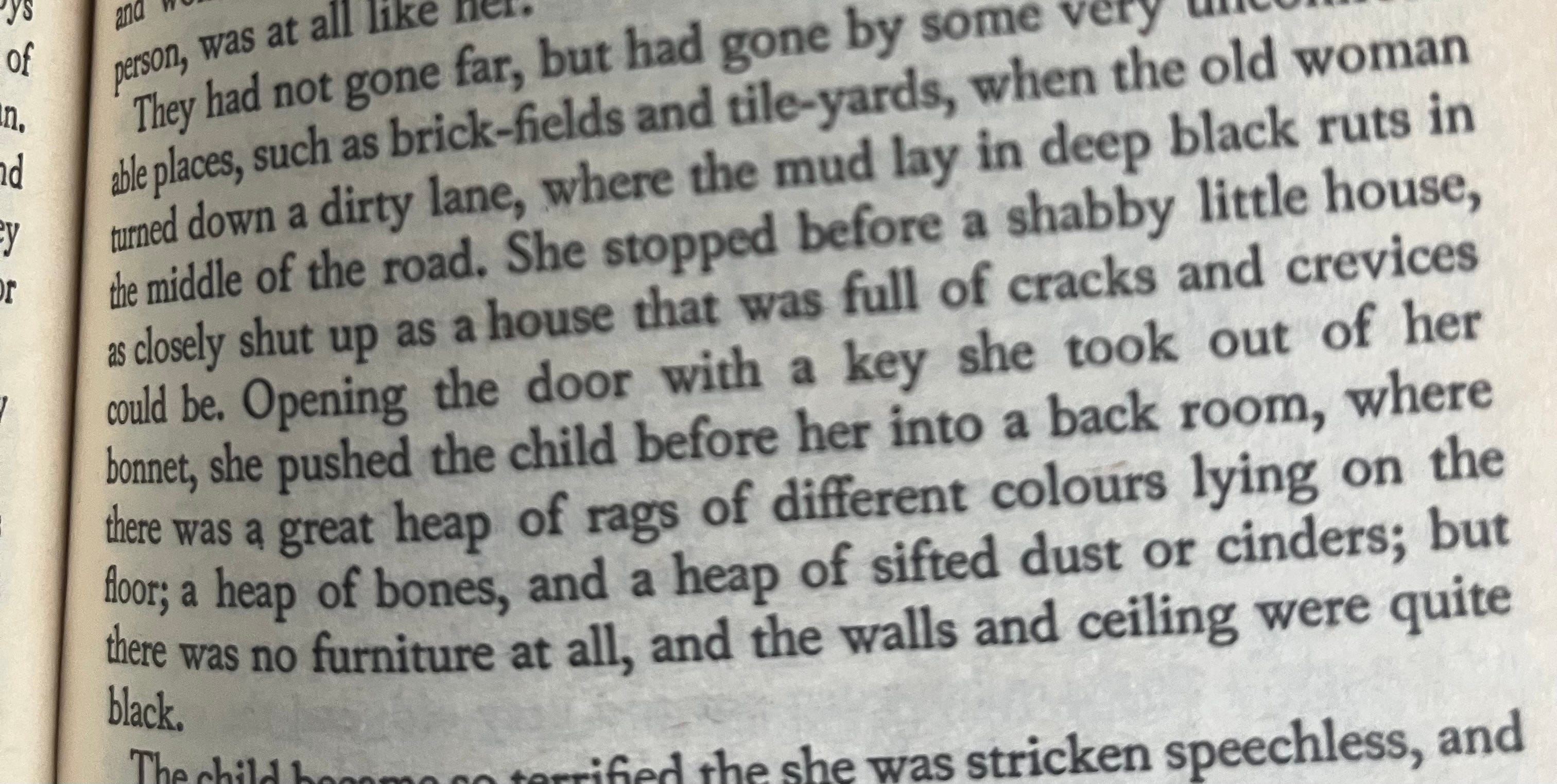
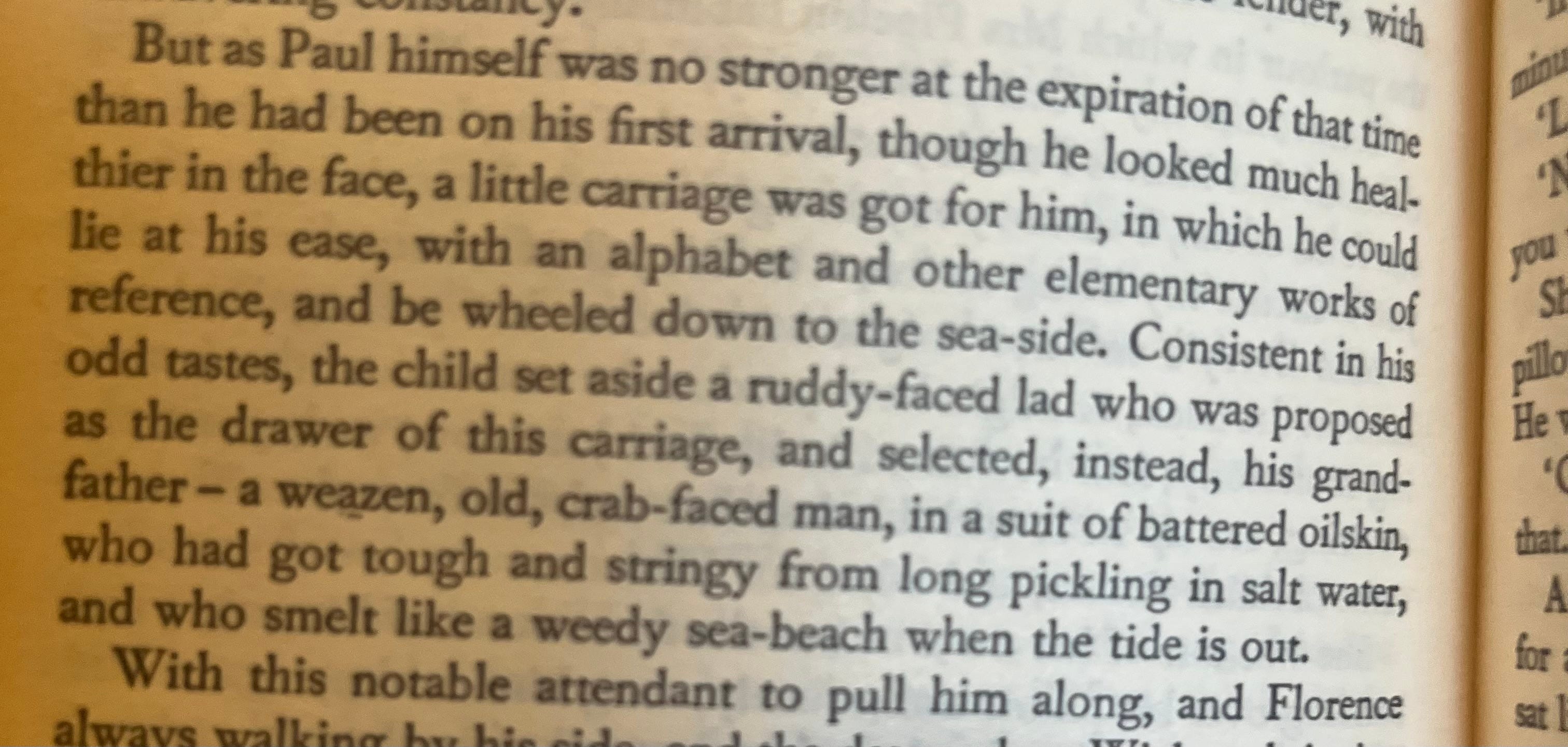
Dickens has put something of himself in Paul Dombey who is described as being like ‘an old man or a young goblin’ Paul likes to be around the eccentric, old and smelly, to feel close to death.
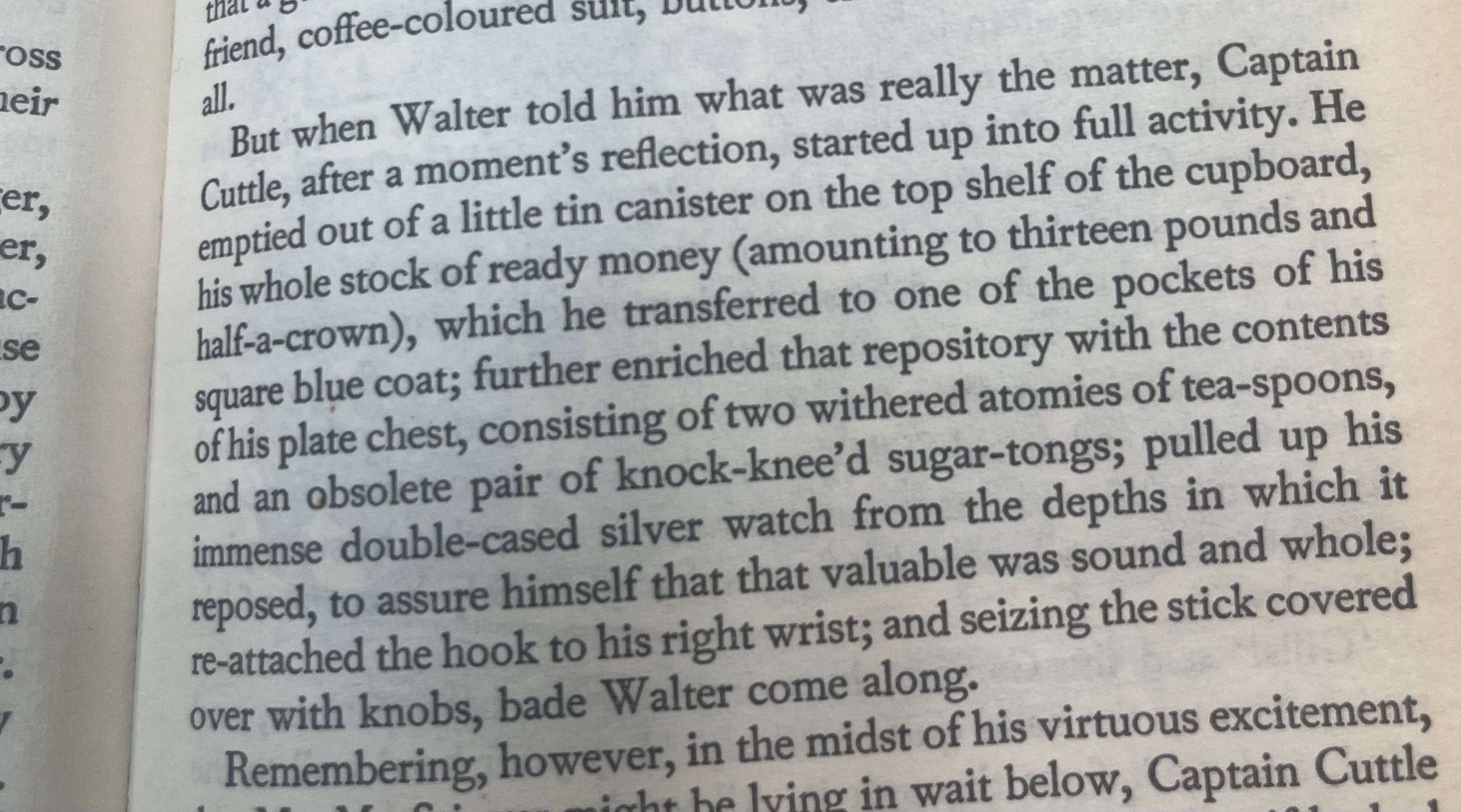
We live in a very sentimental era, so you would think Dickens would be fashionable again, but I think who and what he often sentimentalises we find distasteful ( beyond the children, it is little old drunk men with big hearts, the unglamorous poor, those with unfair debt). Here is Captain Cuttle in Dombey and Son gathering his spare change and sugar-tongs to try and pay off his friend’s enormous debt.
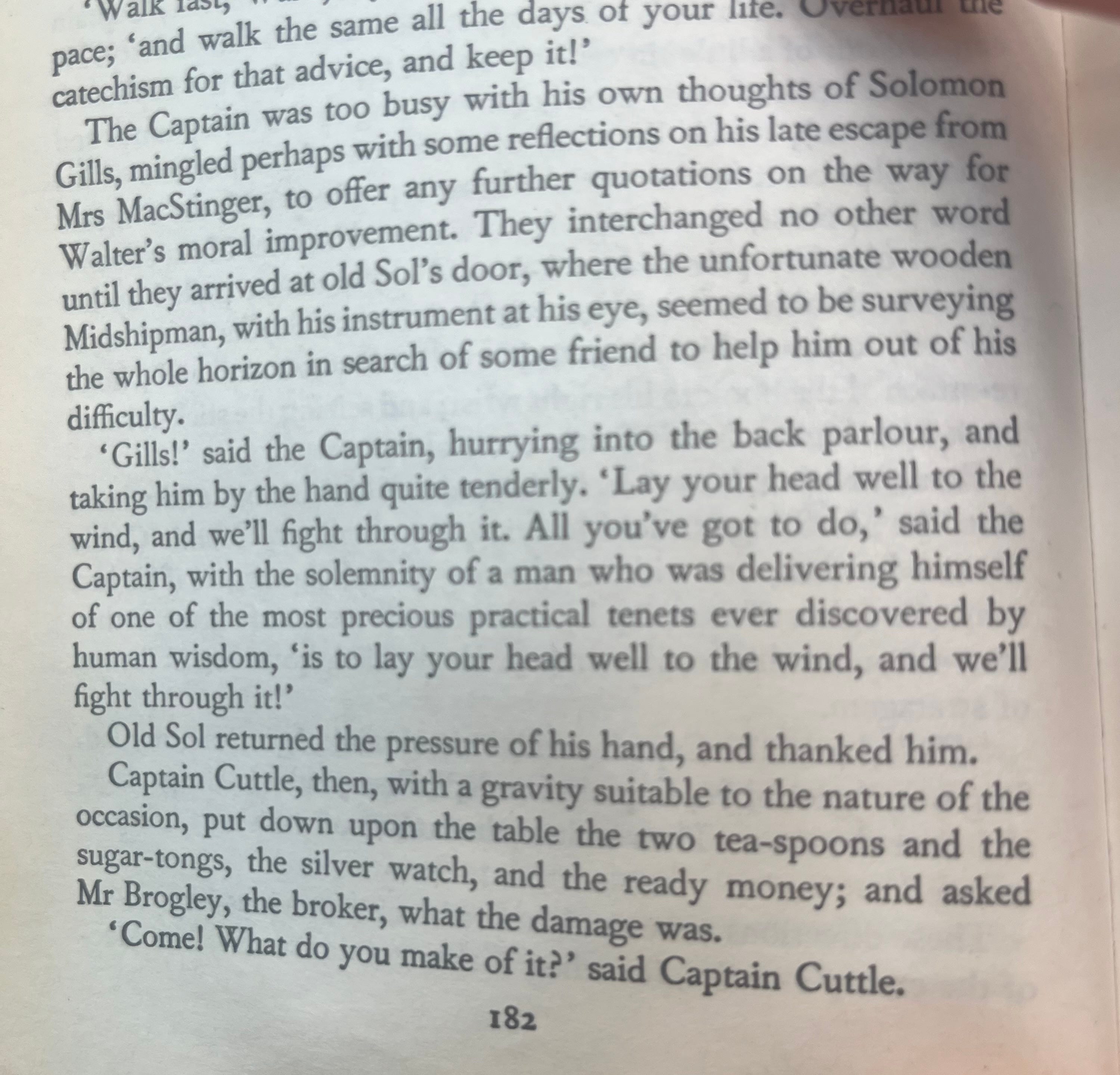
His sentimentalism is also deliberately humorous as you can see in the above extracts. As Carey writes of Dickens as a comic writer ‘“Tragedy is tender to man’s dignity and self-importance and preserves the illusion he is a noble creature. Comedy uncovers the absurd truth, which is why people are so afraid of being laughed at in real life”
When Oscar Wilde said, "it would take a heart of stone to read the death of Little Nell without laughing" it ignores that The Old Curiosity Shop is at points, like all the novels of Dickens, very funny. ‘Humankind’s attempts to surround its puny concerns with gravity and decorum seemed to Dickens hilarious,’ writes Carey. He also notes that Dickens is inconsistent and contradictory and I think a writer would be boring if they weren't.
Why does Dickens baffle and confuse so much these days? An inability to understand his work was recently used as an example of growing illiteracy.
Dickens is also too exposing for contemporary readers . There is too much of Harold Skimple, the original man-child, of Bleak House in ourselves. Having hot house nectarines for breakfast he says:
‘Here I am! This is my frugal breakfast. Some men want legs of beef and mutton for breakfast; I don’t. Give me my peach, my cup of coffee, and my claret; I am content. I don’t want them for themselves, but they remind me of the sun.’ You can basically see the instagram post of this. He makes fun of the greedy rich, but also the faux-frugal, the luxury of simplicity.
On the In Our Time episode on Dickens it reminds us that though Dickens was taken out of school and forced into child labour in a factory, he never published his memoirs about it during his lifetime. He transmogrified the experience into art, and tried to hide that history of himself when a very modern response would be to try and bank in on, exaggerate and form one’s whole identity around a difficult experience. Perhaps we would love him more now, if he had.
Nabokov’s dismissiveness of ‘yarn spinning’ or plotting in praising Dickens says something too. Carey writes ‘what makes him unique is the power of his imagination and, in Kafka’s phrase, its ‘great careless prodigality’- careless because extending itself typically into odd angles and side-alleys of his subject’ Our lives are now all distracted odd angles and side-alleys (seemingly, but actually dictated by big tech) but we have little appetite for distraction from the missionary thoroughfare in a work of fiction, and a novel, if not completely plotty is dismissed as ‘just vibes’ and the vibes of Dickens are thought too bizarre.
A favourite moment in Dombey and Son which captures this poetic waywardness:
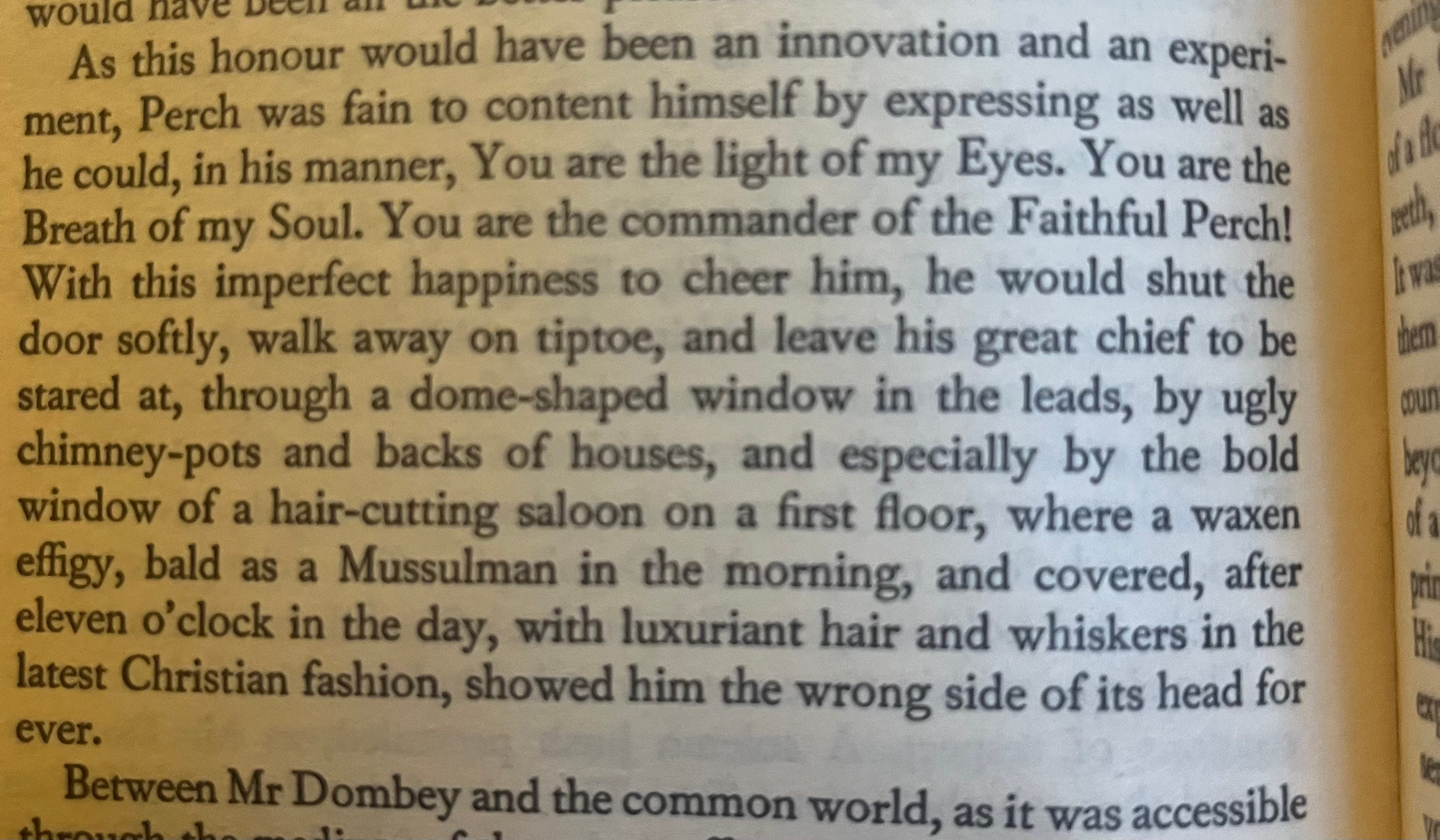
Some other things:
I have a new story, Mozart Balls in Granta, which will be free to read online again for the first two weeks in March.
On March 14, in Foyles from 1-2 pm I will be at the ‘writer’s advice’ booth (here is some: always have a day job and don’t take anything personally) I am also speaking at the London library on a panel on march 12, at the London library. Both are for the launch of an anthology I am part of ‘Magic and Mechanics’ on writing short stories.
I loved that. ‘Bum jobs gone wrong.’ One review of my Seven Nights at the Flamingo Hotel was, ‘if you are bum obsessed you will love this book.’ 3 stars. Someone wrote this about my Saltburn, ‘Drew Gummerson is evidently a writer from the "more is more" school of creativity, like a speeded-up Dickens with additional body-parts.’ Of course, I like all those odd nooks and moments, lists.
Teaching in Prague after communism I had a class which contained a former film star, a tv presenter, a journalist, teachers, a road sweeper, and someone who worked in a snuff factory. She was my favourite and looked exactly like you would imagine - pale white skin, straight black hair, androgynous, black clothes. She was my favourite. ‘Do you have a brother?’ I once asked. I wanted to be part of that family.
That was a great read. I started reading all the Dickens novels in order in 2012 because it was his 200th birthday and I thought it would be a cool thing to do. It was. When I visited the museum, there was a dining room, set up with references to his friends and colleagues, as if they were all in after-dinner discussion with each other. The sheer number and complexity of his characters is breathtaking.