Humbug!
choirs, ufos, hippos, more henry james

This week a friend took me to an evening choir performance in the old Princess street gardens church where Agatha Christie was married. There were some lovely bits, some Peter Warlock and Benjamin Britten’s Levy-Dew and Jane Austen’s prayers set to music (her prayers are beautiful and worth seeking out, I love the one ‘ Another day is now gone’ ) but there was also one Scottish hymn with a frightfully fruity organ accompaniment, like something from a 1950s B movie, more UFO descending than Christ ascending. I started to giggle and couldn’t stop, though I looked at the floor and put my scarf over my mouth, there was something simply ludicrous about the sound , and the solemn listening it required. I was afraid my friend would giggle too if I looked at her, or be offended by my giggling or make me giggle more. Oh why did we sit so close to the front! What a childish woman I am! Then I saw that a dignified looking elderly lady in front of us was giggling too. There was nothing wrong at all with the choir’s singing, they had quite beautiful voices. During the interval my friend agreed by turning to me with a look, and we overheard someone else in the drinks queue also describe it as something from an old alien movie. Can any organ music besides Bach not be fruity? My friend sent me some of Britten’s ‘The Missa Brevis’ but I was not convinced. The church also had a ghastly bronze statue of the Virgin Mary and Christ child where it looked like his legs were her legs.
What do you do if you get the giggles and you know its rude? It happens to me at poetry readings, concerts or in small city commercial art galleries if I find something bad and ridiculous. I call it uncontrollable criticism.
Still, choral concerts are a fashionable thing to go to in my books, whereas spoken word or performance poetry events are unforgivable. I just picked up Thomas Hardy’s Under the Greenwood Tree which is about a village choir upset at a ‘new fangled organ’ a vicar brings in. I am on the lookout for lines in it describing how horrid the organ can be, though I am fascinated by how old an instrument it is. Yes, organ tunes have been tooting along to civilisation since antiquity. Kind of gives an undignified vibe to the whole shebang.
I rewatched The Apartment last week and also saw the Iranian film It Was Just An Accident. Both are masterpieces of tragicomedy and prove the point that narrative tragedy doesn’t work unless there is some aspect of humour, however dark.
I was quite moved seeing The Apartment a second time than I was the first, years ago, probably with friends, but I went to the cinema alone and I think alone is the correct way to see it. It is about loneliness but also defines love better than any other film. The heroine Fran realises that love isn’t a fancy dinner or a promise but caring for someone at their lowest point. CC Baxter has to learn not to be a people pleaser and pushover before he can have a healthy, sustainable romantic relationship. The best moment in the film is a close up of Fran’s face as she realises Baxter is the one who truly loves her and she loves him too. Thank goodness she has it in time. How horribly haunting if she didn’t have it until 70 years later, which I suspect happens to some people. As Baxter’s doctor neighbour says to him, be a mensch! One of those films which is worth it for the details as much as the narrative: Baxter’s outdated, Gothic apartment, his tinfoil ready meals put into an old oven, spaghetti made with tennis rackets, frozen daiquiris, and broken pocket mirrors which allow characters to make blunt but true metaphors.
It Was Just An Accident by Iranian director Jafar Panahi is about a chance encounter between a man who was tortured in prison under Iran’s current theocratic fascist regime, and his torturer, except he is not entirely sure it is him because prisoners were blindfolded, but he thinks he recognises the squeaky sound of his fake leg. He gathers together various other former prisoners to see if they can confirm its him, and they enter a moral maze over whether retribution is just, what it will do to their own humanity and whether it would make them just as bad as the regime and its puppets. The film was made covertly and its director has once again, been sentenced to prison. I highly recommend!
I read Andrew Miller’s The Land in Winter and I was very pleasantly surprised by how weird it is, I really loved it. There is a scene where a woman wakes up in a run down boarding school for blind children after fleeing her philandering husband (being in his mind for some parts made me really wince because its so painfully true to how indifferent someone can be when in a marriage or relationship ) and there is an ever present theme of UFOs. If he were a woman author he would definitely be labelled ‘weird girl fiction’ but there is a tendency to market British male writers of a certain age as sparse, serious and plain as possible despite them being quite wacky (see Ishiguro and MacEwan)
I also read Washington Square. It involves the reader in the narrative in a way I have never experienced before. It gives you a shameful sense of complicity in the suffering of one character. In the first half there is a battle of wills between two men, Dr Austin Sloper and Morris Townsend. Dr Sloper is a rich doctor, Morris is the physically beautiful but poor suitor of his daughter who has a large inheritance. Neither think the daughter, Catherine, is clever or beautiful and neither really like her. Dr Sloper knows Morris just wants Catherine for his money, and Morris insists he doesn’t, though he does. Dr Slopers sister, Lavinia uselessly meddles in the whole thing to make up for the lack of romance in her own life. Dr Sloper had disastrously left Catherine’s education in her hands years earlier and Catherine’s tragedy is that she doesn’t have any wit or intelligence to compensate for her dull looks or help her navigate her life and make firm decisions.
“Try and make a clever woman out of her Lavinia; I should like her to be a clever woman.”
Mrs. Penniman, at this, looked quite thoughtful a moment. “My dear Austin,” she then inquired, "do you think it is better to be clever than to be good?”
“Good for what?” asked the doctor. “ You are good for nothing unless you are clever.”
Both Dr Sloper and Lavinia are wrong in their own way here.
In a very funny scene Lavinia asks Morris to meet her in an out of the way ‘oyster bar’ for privacy to discuss her niece and is dismayed when Morris ruins the romantic nature of the scene by ordering oyster soup. Of course any crass erotic innuendo this might signal is beyond her comprehension as is the knowledge that Morris hates her too. Neither her or Catherine can read sarcasm or double meanings. Both see Morris’s beautiful physical features as a sign of inherent goodness, whereas Catherine’s goodness and sweet, loyal nature are disregarded and seen as an annoyance because of her lack of beauty.
The whole first half of the novel is terribly funny, and Catherine is slow minded and stubborn with nothing interesting to say.
On hearing her father is taking her to Europe, Morris asks
“Should you like to see all those celebrated things over there?”
“Oh no, Morris!” said Catherine, quite deprecatingly.
“Gracious heaven, what a dull woman!” Morris exclaimed to himself.
The trip to Europe is intended to escape Morris and to ‘polish her’ but she has no reaction whatsoever to all the cultural attractions her father takes her too. It is too late. She is a horrifically boring companion mainly of his own making by offloading her education onto Lavinia, though he denies any responsibility for it. “She failed to gather animation from the mountains of Switzerland or the monuments of Italy.”
“She is about as intelligent as the bundle of shawls” the doctor said.
There is near the end, a tonal switch and you are suddenly in the hidden depths of Catherine’s brokenness and mental blankness, and you feel horrible for laughing at her earlier on. When a man comes along who really loves her and sees her goodness, she rejects him, she doesn’t have her Fran moment. The novel doesn’t come across as misogynist in anyway, but could be read as a subtle tale on why everyone should decently educated even if their potential isn’t great, to aid them in making smart decisions about their lives, but also to fill the emptiness of time in a fulfilling way if things don’t work out.
The true passion in the book, is really between Morris and Dr Sloper. While Dr Sloper and Catherine are in Europe, Morris spends all of his time at their house, visiting Lavinia but mainly lounging in Sloper’s office, touching his books and drinking his wine. Catherine is just an instrument to Dr Sloper’s lifestyle, not just his money but his sophistication ( it is important to note that Morris is fatherless) I’ve had something similar before admittedly, where I was more in love with a person’s parents than the person themselves and had much more in common with the parents and wished to belong to them. Morris and I have a bit of Helen Schlegel in us in that sense, though I consider Helen and I less devious! The last scene of the book is utterly haunting and grotesque. There was a 90s film adaptation of the book, which looks quite serious, but I think it would make an excellent dark comedy. A much used insult in the book is ‘humbug’which I shall adapt, it doesn’t have such a Dickensian ring to it if you remove the “bah”
I seem to be working my way through Henry James, any recs on which one next? Was thinking The Golden Bowl
I am reading Dombey and Son having read all the ‘major’ Dickens and really like this line
“But competition, competition- new invention, new invention- alteration, alteration- the world’s gone past me. I hardly know where I am myself..”
I have a lot of inner rage and morbid depression but I find ‘bodycombat’ classes are a big help recently and all your thoughts sort of leak out with your sweat. They are also slightly ridiculous, like you have to pretend you are attacking someone while a technofied version of the Game of Thrones theme tune plays so you end up laughing and high kicking at the same time. I feel ready for a wizard troll quest.
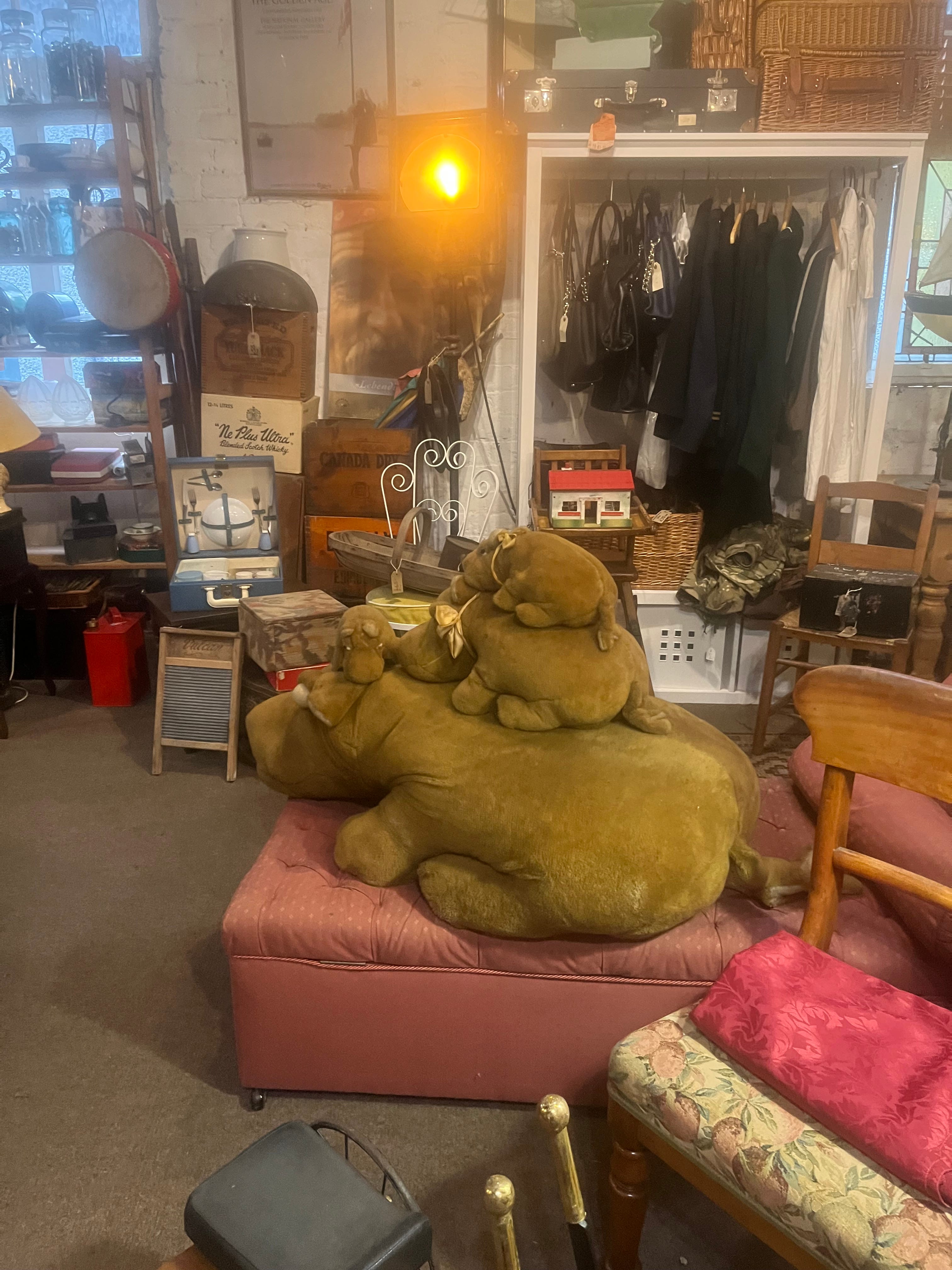
I saw this giant swampy hippo family at an antique shop in Newington. I was always jealous when young of other children with enormous stuffed toys but in retrospect I am glad I didn’t have any they are all abit seedy and seem like the territory of disturbed rich children.
Next week I will be posting a paywalled festive story (about fish! naturally, as I am from a culture which eats fish for Christmas dinner instead of turkey.Christmas always has a gloomy fish atmosphere to me ) as a thank you to paid subscribers for all your support.
edit: Oh god I put James instead of Peter for Warlock. Do forgive me.
Have you read The Ambassadors or Wings of the Dove? I love these two for their wickedness.
I am not sure the extent of your James reading but leaping from WS to GB could prove frustrating. He wrote no two more dissimilar works. “The American” might be a good next step or the delightful “The Bostonians.” I loved every page of those novels. His works after 1897 have a significantly different timbre.